Monday October 19, 2026 | by Mathias Bigger |
We are long a sizable position in ACOG. Here is why.
What Alpha Cognition does
Alpha Cognition (NASDAQ: ACOG) produces ZUNVEYL to treat long-term care patients with Alzheimer’s disease . The stock trades around $9 with 21.8MM shares outstanding and ~3MM warrants at ~$7.25 exercise price. The company had $41.4MM of cash as of June 30, 2026, with no debt. It is cash-flow negative and expects to reach operating breakeven in 2027.
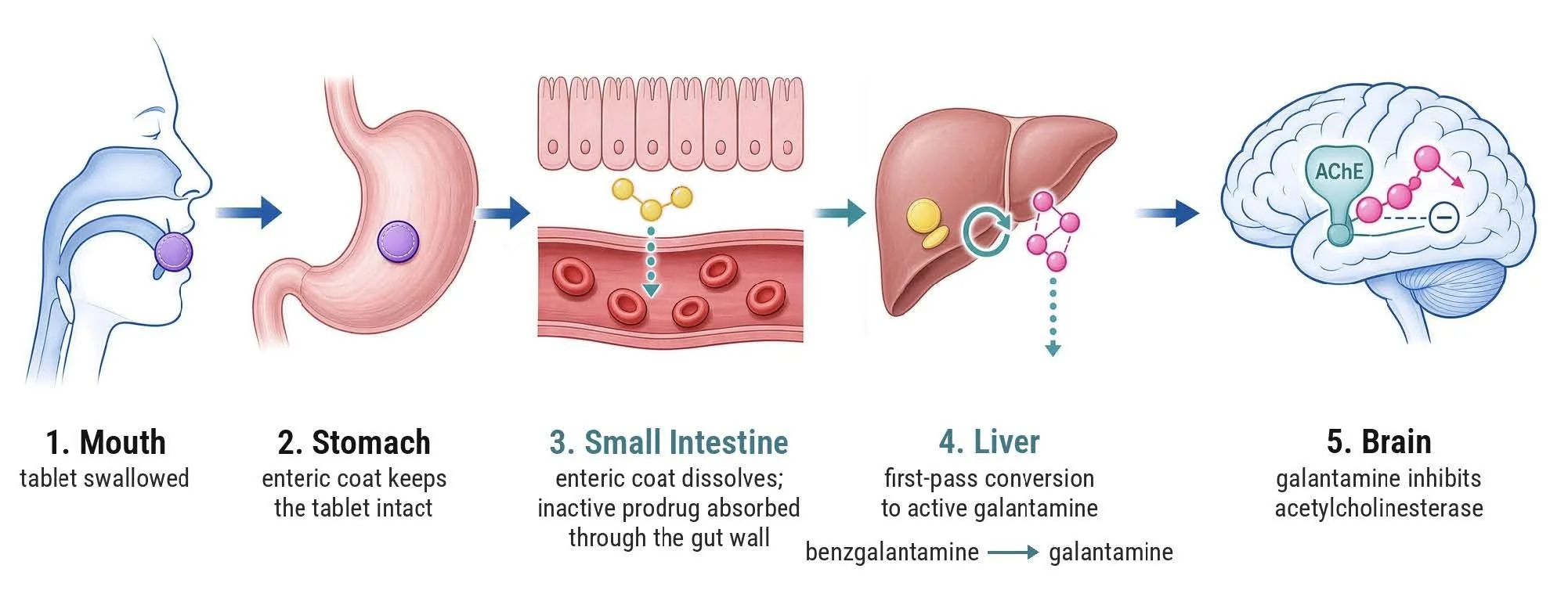
ZUNVEYL, FDA-approved in July 2024, is a delayed-release prodrug of galantamine, an acetylcholinesterase inhibitor. It is designed to pass through the stomach inertly and convert to galantamine in the liver, which is the company’s answer to the nausea and vomiting of older drugs in this class. Approval rested on galantamine's old trial data, plus three bioequivalence studies in healthy adults. Same drug designed to limit GI side effects, simple and elegant.
Pharmacokinetics of ZUNVEYL
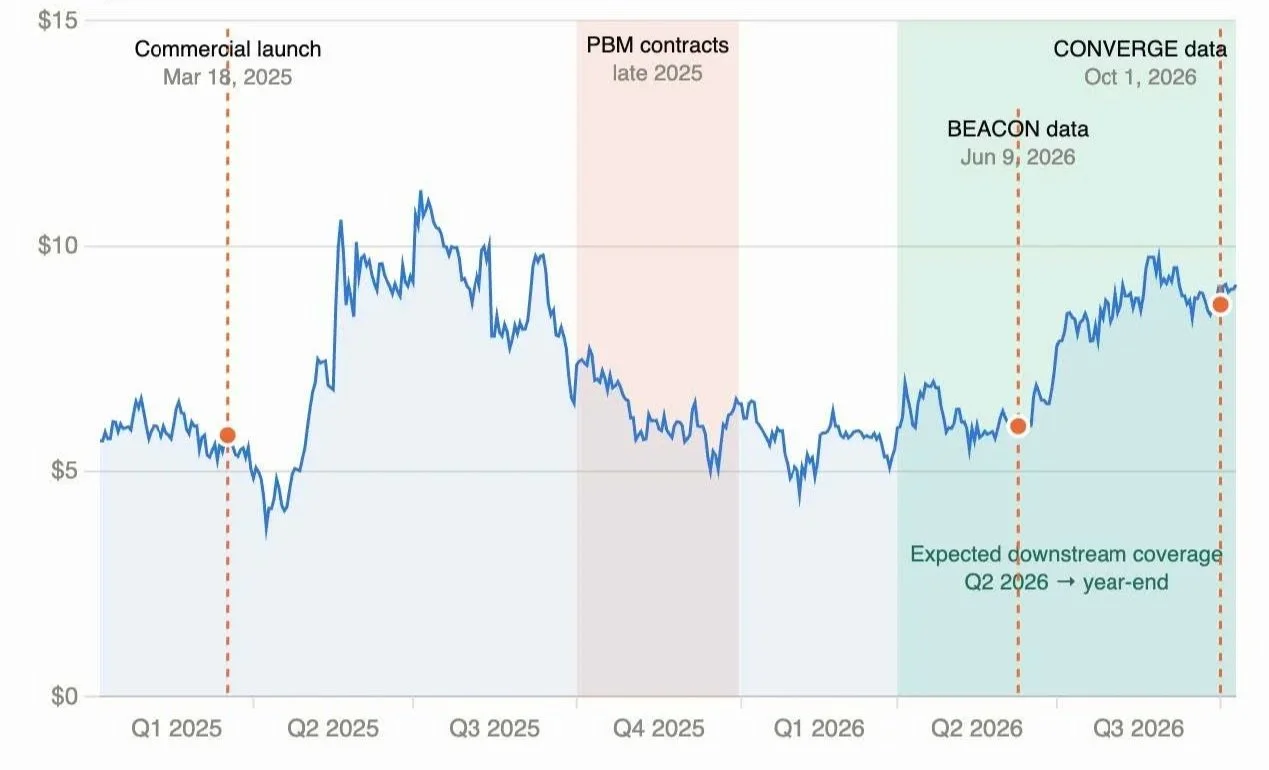
Commercial launch commenced in March of 2025. The market was anticipatory, and two quarters after launch the stock doubled from under $5 to over $10. After three quarters (Q2 2025 to Q4 2025) of commercial exposure, revenue had only grown from $1.7MM to $2.79MM. The market assumed that it was an uphill battle in a space dominated by cheap generic acetylcholinesterase inhibitors. The stock round-tripped to $5 in Q4 2025.
Alpha Cognition’s Stock Price and Meaningful Events
The Inflection
Alpha Cognition began receiving growing amounts of positive prescriber feedback that ZUNVEYL patients were showing benefits beyond marginal GI tolerability. In late Q4 2025, Alpha Cognition received contracts with two major PBMs covering 45M lives.
Investors began anticipating an inflection point.
Alpha Cognition’s Revenue Metrics
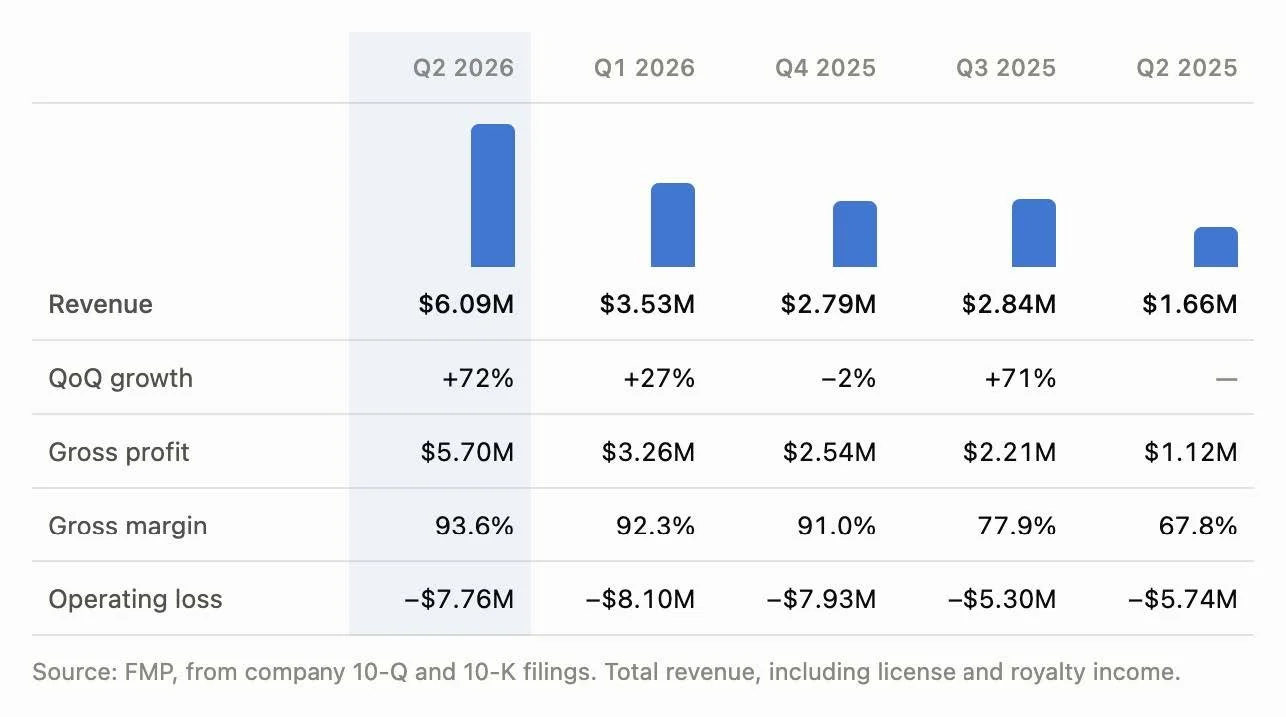
At the end of Q2 2026, we saw the first inflection signal when quarterly product revenue jumped to $6MM, up 72% from Q1 2026, on 8,294 bottles. Management attributed growth to organic demand. In Q2, 76% of 1,347 writers placed a repeat prescription, and 81% of 1,095 homes with a prescription reordered. The prescribers who wrote ZUNVEYL are continuing to write it.
The shocking part: on the Q2 earnings call, management said plan implementation was “roughly consistent with Q1” and “our 16% contracted open book of business is consistent since last quarter.” Covering analysts and the company expected implementation to start growing in Q2 2026, but it did not. The revenue grew anyway.
At launch, ZUNVEYL’s only evidence was bioequivalence in healthy adults. That is changing. The company is accumulating data to open the eyes of payers to the downstream benefits of ZUNVEYL.
The Dam is Filling
Since late in the second quarter, Alpha Cognition has released the following two datasets exploring ZUNVEYL’s benefits beyond GI tolerability.
BEACON (June 2026) is a Phase IV, retrospective, observational study. 21 investigators reported on 162 long-term-care residents with mild-to-moderate Alzheimer's who were switched to ZUNVEYL after a prior acetylcholinesterase inhibitor (AChEI), and stayed on ZUNVEYL for 3 to 12 months. The outcomes are investigators' global impressions, not scored scales. Providers reported cognitive improvement in 92% of patients, neuropsychiatric improvement in 93%, favorable ADL changes in 71%, and sleep improvement in 72% of patients who had sleep problems. They reported delaying or stopping a concomitant psychotropic, mostly antipsychotics and anxiolytics, in 80%. Among patients with GI side effects on a prior AChEI, 89% had favorable GI tolerability on ZUNVEYL.
CONVERGE, first cut, (October 2026) is Real-World Evidence using PointClickCare administration records from January 1st 2026 to June 30th 2026 among residents new to this drug class and starting at the initial dose. Alpha Cognition showed 79.1% (159/201) on ZUNVEYL reached a therapeutic dose within 180 days, versus 37.3% (1,570/4,211) on pooled generic donepezil, galantamine, and rivastigmine. Across new users and switchers, the ZUNVEYL figure stayed near 80%, against about 54% for the generics.
ZUNVEYL resident charts showed a net drop in eight medication classes, including antidepressants, antipsychotics, anxiolytics, sleep aids, and gastrointestinal drugs. Generic charts showed a net increase in all eight medication classes.
As patient initiation continues to ramp, more, higher-quality data will be generated. The company has two more cuts of CONVERGE planned for release in December 2026 and March 2027 with other studies underway. RESOLVE, a prospective outpatient study that enrolled its first patient in June 2026, will follow neuropsychiatric symptoms, adverse events, persistence, and discontinuation in about 150 patients through the second quarter of 2027.
Plans need a reason to pay $870 a month in a drug class with generics priced at $50, and under the Inflation Reduction Act, Part D plans now carry more of that bill themselves. Management says BEACON’s results are already in front of payers, and the company is building pharmacoeconomic analyses from BEACON and CONVERGE for formulary negotiations. The coverage case is being built one dataset at a time.
While the data is convincing, the importance lies in what it describes: a completely different day in a nursing home, a massive cost and burden reduction for the facility and payer, and most importantly a better quality of life for the residents.
A Look Beneath the Surface
Compared to generics, ZUNVEYL is expensive, but in a nursing home the price of the drug is a smaller cost in the formula for the overall intensiveness of Alzheimer’s patients. Let’s go over the meaning of the datapoints from the BEACON and CONVERGE studies with regards to patient quality of life and economic benefit.
Patients actually reach the dose that works. Galantamine’s very own trials showed its benefit kicks in at 16 to 24 mg/day, but nausea prevents many patients from getting there. CONVERGE showed only 37% of residents who started on pooled generics, like galantamine and donepezil, reached a therapeutic dose within six months. The facility and payer are paying for the generic, the nursing time to administer it, and its side effects, at a dose below where the trials showed it works. A cheap drug that never reaches its effective dose isn’t cheap; it’s useless.
79% of residents on ZUNVEYL got to the therapeutic dose in the same 6 month period. On top of an effective drug, this means fewer residents stopped for side effects, with fewer restarts and GI workups, reducing the overall drag created.
Better nights. Fewer nighttime awakenings and less wandering for the resident means less staff time at 2 a.m. The resident is rested and calmer the next day. For the system it is fewer as-needed hypnotics, fewer falls, and fewer agitation episodes that start from broken sleep. All extremely burdensome for already understaffed homes. The benefit proliferates.
Better activities of daily living. These include dressing, eating, transferring, and toileting with less help. For the resident it is more of the day done without a second person. For the payer and the home it is the expensive part of Alzheimer’s: staff minutes per resident. Just a few days ago, the Long Term Care Community Coalition’s October 2026 report, built from CMS Payroll-Based Journal filings for 14,690 homes, found more than 9 in 10 facilities below expected staffing. Any improvement in the resident’s ability to live independently makes the final part of life more humane and graceful, while unburdening the overworked staff.
Fewer add-on drugs. The resident is less medicated, with fewer adverse effects and less susceptibility to non-compliance of a treatment plan. For the nursing home, that means fewer pills on the cart, fewer sedation and fall risks from antipsychotics, and less stomach medication started to treat nausea from the Alzheimer’s drug. For the facility and payer, each dropped antipsychotic or GI drug is a dispensed product, a monitoring task, and a possible adverse-event cost avoided. Antipsychotics carry regulatory scrutiny discussed below. Calculating the cost benefits of avoiding antipsychotic drugs such as Rexulti ($20,000 per year) varies by patient, but we expect the savings to be significant over time.
Rating improvements. The CMS star rating system is a five-star quality rating system across 3 domains: health inspections, staffing, and quality measures. ZUNVEYL impacts two of these domains.
First, staffing measures nurse staffing levels relative to residents’ needs. Investigators reported, ZUNVEYL lowers residents’ needs through less insomnia, increased GI tolerability, and the other points discussed.
Second, quality measures the percentage of long-stay residents receiving an antipsychotic medication and the percentage of residents experiencing one or more falls with major injury. ZUNVEYL is associated with positive impacts on both outcomes.
Low ratings mean fewer referrals, more regulatory attention, and in some states Medicaid penalties. That pressure is material for the majority of nursing-home residents whose primary payer is Medicaid (about 63% according to KFF). For a facility, ZUNVEYL is a quality-measure tool as much as a drug.
Long-term care is where Alzheimer’s drugs are started, stopped, and surrounded by other pills. A drug that actually reaches therapeutic dose, and lets facilities drop antipsychotics and stomach drugs, is worth more than a galantamine tablet failing to reach therapeutic dose in a majority of residents.
If the December and March CONVERGE cuts show similar patterns, the payer case continues to solidify.
BEACON, CONVERGE, and the recent Q2 revenue inflection give us confidence that the dam will eventually break. Downstream coverage can flow, and ZUNVEYL could become the standard treatment in the long term care Alzheimer’s disease market, with potential peak sales of $200MM-400MM according to the company.
ZUNVEYL Beyond the Long Term Care Market
The street values Alpha Cognition for the nursing-home opportunity. This is where a lot of upside hides, because two larger markets sit in the models at zero or close to it.
Long-term care writes about 41% of the class’s prescriptions. The other 59% come from neurologists, primary care doctors, and psychiatrists treating Alzheimer’s at home. These patients experience the same GI problems with generics. It is a more challenging market to enter because of scattered prescribers, no $0 copay, and a bigger salesforce requirement. Management has said it won’t enter outpatient care until it reaches operating profitability, targeted for 2027. The groundwork is being laid anyway.
About 3 million Americans are diagnosed with a brain injury each year. Roughly half are left with lasting memory and concentration problems. No drug is approved to treat traumatic brain injury.
In animal studies, ZUNVEYL shrank brain lesions and sped functional recovery. The road is long: TBI requires full efficacy trials which come with a unique set of obstacles. But, the clock has started with a toxicity study finishing this quarter, and the IND is planned for the first half of 2027. The company estimates the market size at $10B a year.
Conclusion
Our thesis is simple: we are seeing a positive trend that is already showing up in the numbers. Revenue grew 72% in a quarter when plan implementation didn’t move. Prescribers continue writing ZUNVEYL at high rates. Both early datasets point the same way: residents reach the dose that works and downstream benefits flow.
The thesis asks for one thing: that the story keeps doing what it’s already doing. If the data keeps building, coverage should continue following. If coverage follows, long-term care alone is a $200–400MM peak-sales opportunity for a company valued at roughly $200MM today. The outpatient and TBI opportunities come along for close to free.
We are long ACOG. The December CONVERGE cut and next quarter’s contracted book of business will tell us whether the trend holds. So far, it has.
Additional Risks to Consider
Bigger Capital Fund, LP & District 2 Capital Fund LP & related entities are long a significant position in ACOG, but we are aware of the risks outlined in Alpha Cognition’s filings, including but not limited to the risks outlined below.
Commercial launches are subject to unpredictable market conditions and forces.
From the CONVERGE press release “CONVERGE does not establish causality. The analyses were unadjusted for differences in resident characteristics, disease severity, treatment selection, facility practices or other potential confounders. Statistical tests reported in this release were not adjusted for multiple comparisons unless expressly stated otherwise.”
From the BEACON press release “Because BEACON was a retrospective observational study without a randomized control group, the reported observations cannot establish causality and should not be interpreted as evidence that ZUNVEYL caused the reported outcomes.”
The ZUNVEYL use patent no. 9,763,953 expires in December 2026. With no regulatory exclusivity, a generic filer could submit an ANDA at any time. A Paragraph IV challenge to the remaining patents would allow Alpha Cognition to sue within 45 days and trigger a 30-month stay, implying no generic launch before roughly 2029 even with an immediate filing. Formulation and crystalline-form patents are historically more vulnerable to design-arounds and validity challenges than composition-of-matter patents.
Patent No. Expiration Submission Date Protection Point
9,763,953 12/01/2026 08/22/2024 Use
11,795,176 01/13/2042 08/22/2024 Crystalline form
12,208,167 02/26/2044 02/20/2025 Delayed-release tablet
12,551,491 07/23/2045 02/20/2026 Dosing regimen
Disclaimer
Bigger Capital and its principals are long ACOG and may buy or sell shares at any time without notice. This post reflects our opinion and is not investment advice or a recommendation to buy or sell any security. We have not received compensation from Alpha Cognition or any third party for this blog.
The information in this article comes from public sources, including Alpha Cognition’s SEC filings, press releases, earnings calls, and investor presentations, as well as third-party research and industry data. We believe these sources are reliable, but we have not independently verified them and make no representation as to their accuracy or completeness.; readers should do their own research.