Sanuwave (SNWV): Punished for Its Neighbors’ Sins
Monday October 5, 2026 | by Michael Bigger, Mathias Bigger and Patricia Winter|
Sanuwave Health, Inc.’s stock traded near $45 in August 2025. By September 2026 it had fallen to a low of $3.92, a drop of more than 90% in about a year. The market had decided that a wound-care device companyin the middle of the biggest Medicare wound-care crackdown in memory had to be part of the problem. We think the market got that wrong. We also think the next few months give Sanuwave a real chance to fix the reimbursement issue behind the sell-off.
We are long a sizable position in SNWV. Here is why.
What Sanuwave does
Sanuwave, based in Eden Prairie, Minnesota, produces UltraMIST. UltraMIST is a non-contact, low-frequency ultrasound system that sends energy into a wound through a fine saline mist. The device never touches the wound. The mist cleans the wound bed with acoustic debridement, breaks down biofilm, calms inflammation, and helps chronic wounds resume healing. UltraMIST has been FDA-cleared since 2014 and is used for diabetic foot ulcers, venous leg ulcers, pressure injuries, post-surgical wounds, and burns.
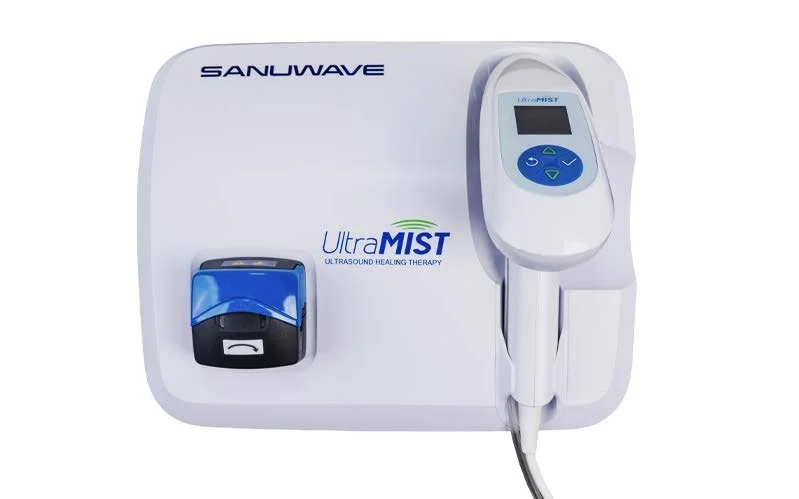
Sanuwave’s Ultramist System
The business follows a razor-and-blade model. A clinic buys a new system (shown above) for $35,000,then buys a single-use applicator for every treatment. More than 1,400 systems are in the field, having performed 2 million procedures and counting since clearance. The evidence base includes 18 peer-reviewed studies, 8 randomized controlled trials totaling 509 patients, and 3 meta-analyses. The Mayo Clinic, Baylor St. Luke’s in Houston, and USC’s limb preservation program all use UltraMist. Medicare pays for the treatment under one billing code, CPT 97610.
What caused the drop
Two shoes dropped back to back.
The first shoe to drop was the skin-substitute spending crackdown. Medicare spending on skin substitutes had grown into a $15 billion category, with a large portion built on overbilling. In January2026, CMS responded by cutting skin-substitute payment by 90% to 95%, to about $127 per square-centimeter. CMS paired these cuts with aggressive audits and retroactive clawbacks. Some wound-care providers had clawbacks in the hundreds of millions of dollars. Practices closed. Their liquidations dumped used UltraMIST systems onto the secondary market, eating into Sanuwave’s new-system sales.Those practices were profiting from skin-substitute billing, not CPT 9761, discussed in the next section. In June 2026, Sanuwave cut its Q2 revenue guidance, and system sales for the quarter fell 34% year over year.
The second shoe dropped this summer, as CMS pillaged additional codes on the basis of hunting fraud. An unnamed party nominated 97610 as a “potentially mispriced code.” CMS leaned on a 3rd party RAND Corporation analysis showing the code’s supply input was too high. On that basis, the proposed CY 2027 Physician Fee Schedule cut the supply input for 97610 by 69%. A reduction from $320.18 to about $100. Sanuwave’s CEO noted, “just when you think the last CMS shoe has dropped in the wound care space, there is another.” In August, Sanuwave withdrew its full-year 2026 revenue guidance of $51 to $55 million until the final CMS ruling is published.
This sequence took the stock from the forties to under four dollars.
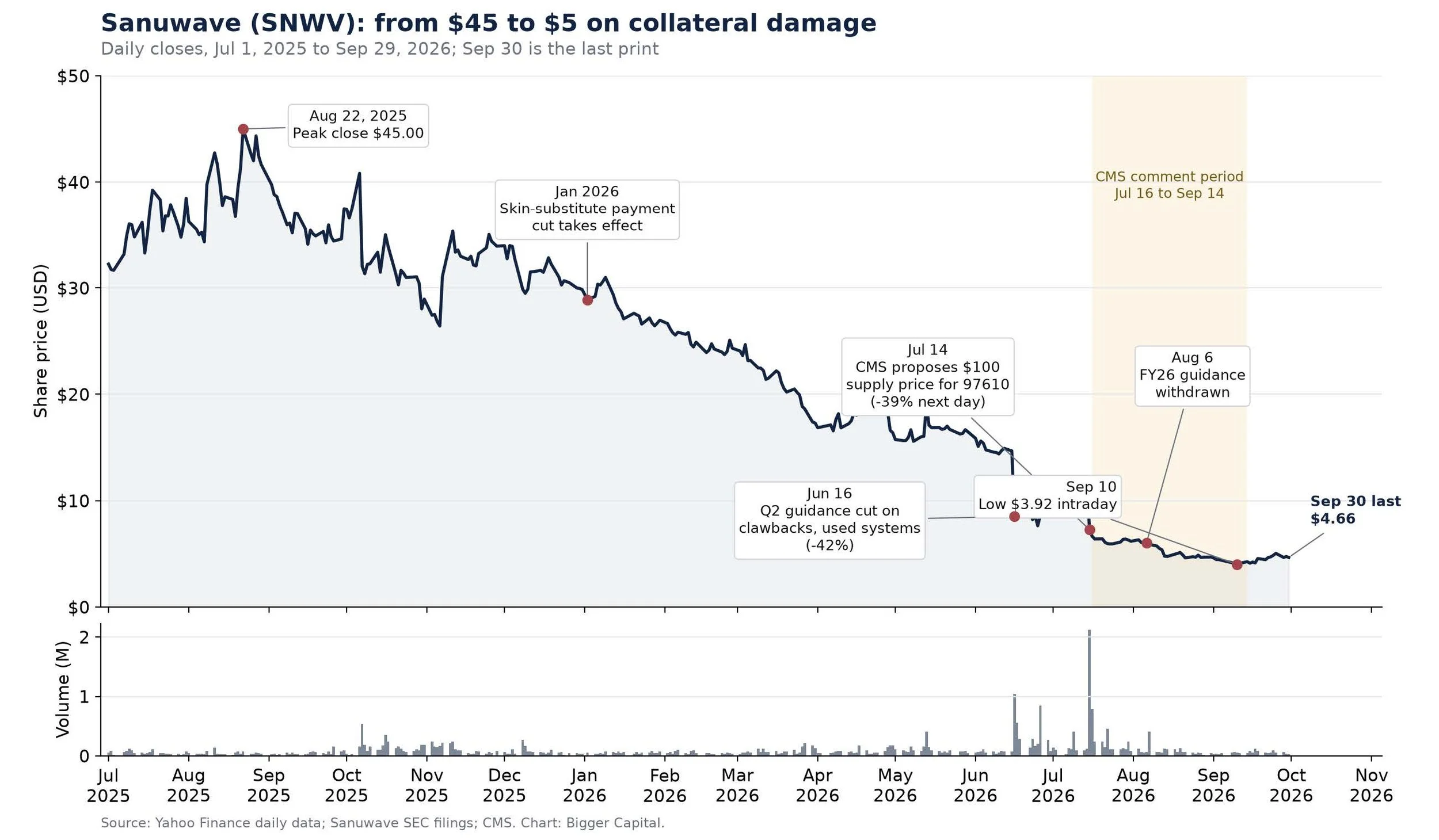
From $45 to about $5. Daily closes from July 1, 2025 through September 29, 2026. The last point is the September 30 print, about $4.66, not a closing price. The August 22, 2025 peak is the $45.00 close. Shaded band is the CMS comment period. Source: Yahoo Finance daily data; Sanuwave SEC filings; CMS.
Is CPT 97610 and Sanuwave’s market part of the fraud CMS is looking for?
The wound-care fraud CMS is chasing is real - in skin substitutes where products are billed per square-centimeter. This area-based billing style is vulnerable to over- and unnecessary treatment. CPT 97610 can only be billed once per patient per day, the quantity and size of the wounds are not considered. It also cannot be billed alongside other wound procedures on the same day. It has no area add-ons, no depth tiers, and no per-wound billing.
The market that Sanuwave treats has stayed intact despite pre-owned systems hitting the market, and fraudulent centers being run out of business. Patient demand, measured through applicator sales volume, has risen. In Q2 2026, applicator units hit an all-time record, up 27% year over year and 13% from Q1. To re-emphasize: the Mayo Clinic, Baylor St. Luke’s in Houston, and USC’s limb preservation program all use UltraMist.
So, why is CPT 97610 being targeted for mispricing?
The 3rd party RAND Corporation basis for their $100 input figure is a slide from an outdated company investor presentation. RAND logged that slide as if it were a purchase invoice, the type of evidence CMS normally requires to reprice a supply. The $100 figure itself is also seriously flawed.
The current $320.18 figure for CPT 97610 was built by CMS’s own contractor, StrategyGen, in 2018 as the sum of the parts actually used in a treatment: applicator plus sterile saline plus dressings and other supplies. RAND took one line from that list and treated it as the whole. The new proposal gives no value to the other components. That is like seeing a restaurant menu that says “bun: $3,” then declaring the cost of a hamburger is $3 and cutting the reimbursement for the whole meal.
The CMS change is just a proposal and Sanuwave is in the midst of its battle to protect CPT 97610.
The CMS comment period: what Sanuwave, Mayo, and Baylor told CMS
During the CMS comment period which ran from July to September 14th, the company, the patients, the customers and others had the chance to refute the proposal. All comments are available on Regulations.gov.
Three letters in particular deserve attention:
Sanuwave’s letter (September 14, signed by Chairman and CEO Morgan Frank) is a detailed rebuttal.Its central point is simple and, in our view, hard to argue with. The $100 figure CMS used as the price of the full treatment is just the price of a single applicator.
Morgan points out that RAND’s own analysis admits it “cannot verify” key assumptions. RAND assumed UltraMIST accounts for essentially all 97610 billing and that each billing provider owns about one system. Competing devices from Arobella and Vaporox bill the same code, and Sanuwave believes Arobella alone could be a third of Medicare billing. RAND’s comparison to hospital outpatient payment rests on thin data. Hospitals often use the therapy without billing it at all: one major hospital bought about 9,000 applicators in 2025 and submitted about 700 claims. On top of that, CMS proposes raising the hospital outpatient rate for 97610 by about 14% in 2027, even as itproposes cutting the office rate.
Mayo Clinic’s letter (September 1) was sent by Dr. M. Mark Melin, Medical Director of the Gonda Vascular Center Wound Clinic in Rochester. He writes that UltraMIST has been part of Mayo’s standard of care for about 20 years, across four sites on its campus. Mayo uses it for patients whohaven’t responded after 30 days of standard care: pressure injuries, critical limb ischemia, venousleg ulcers, radiation wounds, and diabetic wounds.
Mayo is building its own outcomes data, with a poster on the way to support UltraMIST. He writes that the proposed cut “appears financially unfeasible for many practices to absorb” and that “it would be unwise to render non-economic a procedure that has been so effective for us in reducing downstream costs.”
Dr. Melin notes that he does not have any financial upside to the company.
Baylor St. Luke’s letter (September 8) comes from the six-person wound, ostomy, and continence nursing team at CommonSpirit Baylor St. Luke’s Medical Center in Houston, an 881-bed hospital.The team treats about 250 UltraMIST patients a year. Most cases treated are early deep-tissue pressure injuries acquired in the hospital, to keep them from progressing to Stage 3 or Stage 4wounds.
Medicare stopped paying hospitals extra for those wounds in 2008, and the federal Agency for Healthcare Research and Quality puts their treatment cost at $20,900 to $151,700 each. The letter describes a 75-year-old lung-transplant patient whose sacral deep-tissue injury healed after 15 UltraMIST sessions, at a cost of about $1,100 to $1,800 in staff time and hospital provided supplies alone. The nurses write that $100 does not describe any device we have ever written a purchase order for.”
Put simply, the company making the device, a Mayo Clinic physician with no external incentive, and a hospital nursing team with no financial stake all told CMS that the number is wrong, the treatment ‘s benefit is real and the patients are real.
Why a full review of the code is a reasonable outcome, and why it could help
CMS will publish the finalized fee schedule on November 1, 2026. Sanuwave is asking CMS to maintain the original $320.18 input for 2027, but send CPT 97610 through a comprehensive review. We think this is a reasonable demand for four reasons:
The proposal skipped a comprehensive review process. It repriced a supply line using only one data point that was misinterpreted and mislabeled by a third party: the RAND Corporation. CMS has a strong institutional reason not to finalize a cut using only an investor slide inaccurately used in lieu of an invoice.
CMS’s own reasoning argues against a cut this large. In the very same proposal, any code’s yearly drop is capped in practice-expense value at 5%, because large swings driven by “data anomalies” cause “unintended consequences and distortions.” Revalued codes are excluded fromthat cap on the theory that a revaluation rests on verified resource data. This one most certainlydoes not.
The economics favor paying for UltraMIST. Diabetic foot ulcers are the leading cause of amputation in the United States, numbering roughly 130,000 amputations a year. As the company’s CEO noted, each foot amputation costs the healthcare system about $640,000 over the patient’s lifetime. At that cost, a full treatment course for a couple thousand dollars that heals ulcers and prevents downstream amputations pays for itself many times over. The fee schedule formula does not account for these savings. UltraMIST saves Medicare money, while serving usually unattended rural and immobile patients - one of CMS’s goals. This is hard for anyone in Washington to argue against.
- and this is the upside case - a real review would expose that 97610 is underpriced for its use case. The same design that makes 97610 hard to abuse also causes legitimate multiple-wound treatments to be underpaid. A review could fix that without recreating the abused per-square-centimeter formula, for example with a capped add-on for a second wound. Debridement pay scales with area, skin substitutes pay scale with quantity and area, negative-pressure therapy pay scales with area, the new wound-imaging code pays per wound, and an Unna boot bills per leg. The typical wound-care patient has about 2.4 wounds, according to the largest published cohort study of more than 412,000 patients. If a clinician reaches the max usage of an UltraMIST applicator, CPT 97610 cannot be billed twice on the same day, so the treatment cannot be continued. Prior reviews cut the work value twice, from 0.51 to 0.39, and now physicians get paid about $12.80 for work that takes 30 to 40 minutes. But neither accounted for multi-wound visits or mobile providers’ travel time, and a review built on real invoices and utilization data would have to.
A comprehensive review that accounts for multiple wounds, wound size, and the travel time of mobile providers (about half of UltraMIST volume comes from mobile and home-based clinicians servingrural and long-term-care patients) could reasonably land at a higher value than $320.18. The range of outcomes is wider than the market is pricing, and the top of that range is well above today’s rate. To our knowledge, there are no letters supporting the cut, and over 20 letters opposing the cut with specific regards to Sanuwave’s UltraMIST.
Why the Mayo and Baylor letters matter beyond this proposal
Comment letters are usually treated as noise that disappears once the final rule is published. These two should not be.
Mayo Clinic and Baylor St. Luke’s are some of the most trusted names in American medicine. They wrote, without upside, on the public record, that UltraMIST is standard of care and that losing it would hurt patients. One is a physician with no financial ties to the company. The other is a nursing team that gets nothing from the reimbursement they’re defending. That kind of third-party validation is hard for a small-cap device company to get, and hard for a regulator to ignore.
They also remain useful after the November ruling. These letters support the company’s case in any future RUC review. They help new hospital value-analysis committees and wound-care networks understand the benefit. They support the push to get UltraMIST into clinical guidelines and standard practice. They strengthen the position with commercial payers, Medicare Advantage plans, and the VA, which together made up about 36% of 97610 claims in 2024 by Sanuwave’s estimate. The letters do not need to be shouted about. Used quietly and consistently, they become a tool to add credibility to the whole platform and flatten the learning curve of new customers.
The upside even if CMS doesn’t budge
There is a second path to value that does not depend on winning the comment fight. The office and mobile wound-care market are the most exposed parts of the business to the proposed physician fee schedule. Hospitals, hospital outpatient treatment programs, nursing homes, post-acute facilities, and burn and pressure-injury programs use UltraMIST on a different cost basis. They absorb the cost to get the benefit from patients having shorter healing times, fewer complications, fewer advanced pressure wounds, and fewer amputations, not from a per-visit reimbursement rate.
The company’s CEO had this to say when asked if Sanuwave could theoretically work as a company if the office rate falls under $200: “Yes, but it’s a pivot to hospital, hospital outpatient, nursing home, post-acute, and areas like burn and pressure injury where the payback is cost savings rather than reimbursement rate. Those spaces could easily support revenues 10-20x current rates and these are markets into which the company has been aggressively moving over the last 9 months, but full transitions like this tend to be messy while they occur.”
We take the 10 to 20 times figure as management’s view of the size of the opportunity, not a forecast. Armed with the Mayo and Baylor letters and Mayo Clinic data on the docket, Sanuwave is already positioning itself strongly in this market.
Management has said it would rather keep both markets than trade one for the other. If CMS gets the rate right, Sanuwave keeps its office business and grows into hospitals. If CMS doesn’t, the hospital and facility markets become the main path, and not a completely new unexplored one.
The beast we are dealing with
We want to be clear about the risk. Healthcare is hard, and government agencies are far from predictable. CMS can finalize a bad number even after strong opposing comments, and it has done so before. The final rule could keep the cut as proposed, soften it, or phase it in, and the stock will likely move sharply on the day it is published. Sanuwave carries debt, has withdrawn guidance, and still faces a used-equipment market eating into new system sales. A small-cap company in a sector under regulatory attack can stay cheap longer than seems reasonable.
The pivot carries its own risk. Changing a company’s core market is expensive and slow. Selling into hospitals and nursing homes means longer sales cycles, value committees, group purchasing contracts, and a different kind of sales force. Revenue from the office channel could shrink faster than the new channels grow. If the pivot costs more or takes longer than planned, Sanuwave would potentially need to raise more money, and at today’s share price that would mean real dilution for existing shareholders.
That’s the beast. Here’s why we like the odds. Patient demand, measured by applicator volume, is at a record. The case against the proposed cut rests on a documented, checkable error made by a third party. Independent clinicians at two of the country’s leading institutions have put their names behind the therapy, with supporting data to follow. A proper review could leave the code better priced than it was before any of this started. And if it doesn’t, the company already has a foothold in hospital and facility markets that don’t depend on the office rate. At about $5 a share, the stock is priced as if the worst outcome is already locked in.
We’re long a sizable position in SNWV, and we’re comfortable being early.
This post is about the reimbursement fight, but it isn’t the only reason we own the stock. Sanuwave has more than one free option that the market isn’t pricing, and we’ll write about another one in the coming weeks.
Disclosure: Bigger Capital and its principals are long SNWV and may buy or sell shares at any time without notice. This post reflects our opinion and is not investment advice or a recommendation to buy or sell any security. Figures are drawn from Sanuwave’s SEC filings, public comment letters submitted to CMS under CMS-1848-P, and public statements by Sanuwave’s CEO; readers should do their own research.